You noticed something off with your skin three weeks ago, Googled it, panicked a little, and then discovered the earliest dermatologist appointment available is six weeks away. If that sounds like your Tuesday afternoon, you’re not alone, and you’re exactly why online dermatology exists.
This post breaks down the real differences between booking a virtual dermatologist and walking into a traditional clinic: what it costs, what it’s good for, and when you genuinely need to go in person. No fluff, no scare tactics, just the honest comparison you were looking for.
First, what even is online dermatology?
Online dermatology, often known as teledermatology, is precisely what it sounds like. You take care of your skin issue virtually rather than traveling to a clinic, sitting in a room filled with 2019 magazines, and seeing a doctor for twelve minutes. either by submitting pictures and receiving a diagnosis and treatment plan in a day or two, or by having a live video conference with a board-certified dermatologist.
The two primary formats
The first is synchronous care, which is a live video call in which you have a direct conversation with a virtual dermatologist from the comfort of your own home. The second is asynchronous, or “store-and-forward,” in which you send in a health intake form and images, and the doctor evaluates everything at their own pace before providing a plan.
Both can result in actual prescriptions being issued to your pharmacist, are authentic, and involve certified dermatologists. The main distinction between live conversation and async convenience is how you prefer to communicate.
Think of asynchronous online dermatologist consultation like sending a very detailed, well-lit message to your doctor. You don’t have to coordinate schedules, there’s no hold music, and the doctor still reviews your photos with the same clinical eye they’d use in person.
The Cost Conversation: What You're Actually Paying For
Let’s talk money, because that’s usually where the real decision lives. Traditional dermatology visits aren’t cheap. Between the consultation fee, the copay, whatever your deductible situation looks like, plus getting there and back , it adds up before the doctor has even said hello.
What In-person Visits Actually Cost You
The consultation fee itself is just the beginning. Add parking, gas or transit, and the three to four hours you carve out of your day between traveling, waiting, and the appointment itself , and what started as a skin check becomes a significant time and money commitment. If you’re hourly or freelance, that lost work time isn’t invisible. It has a real dollar amount.
What Online Dermatologist Consultations Cost
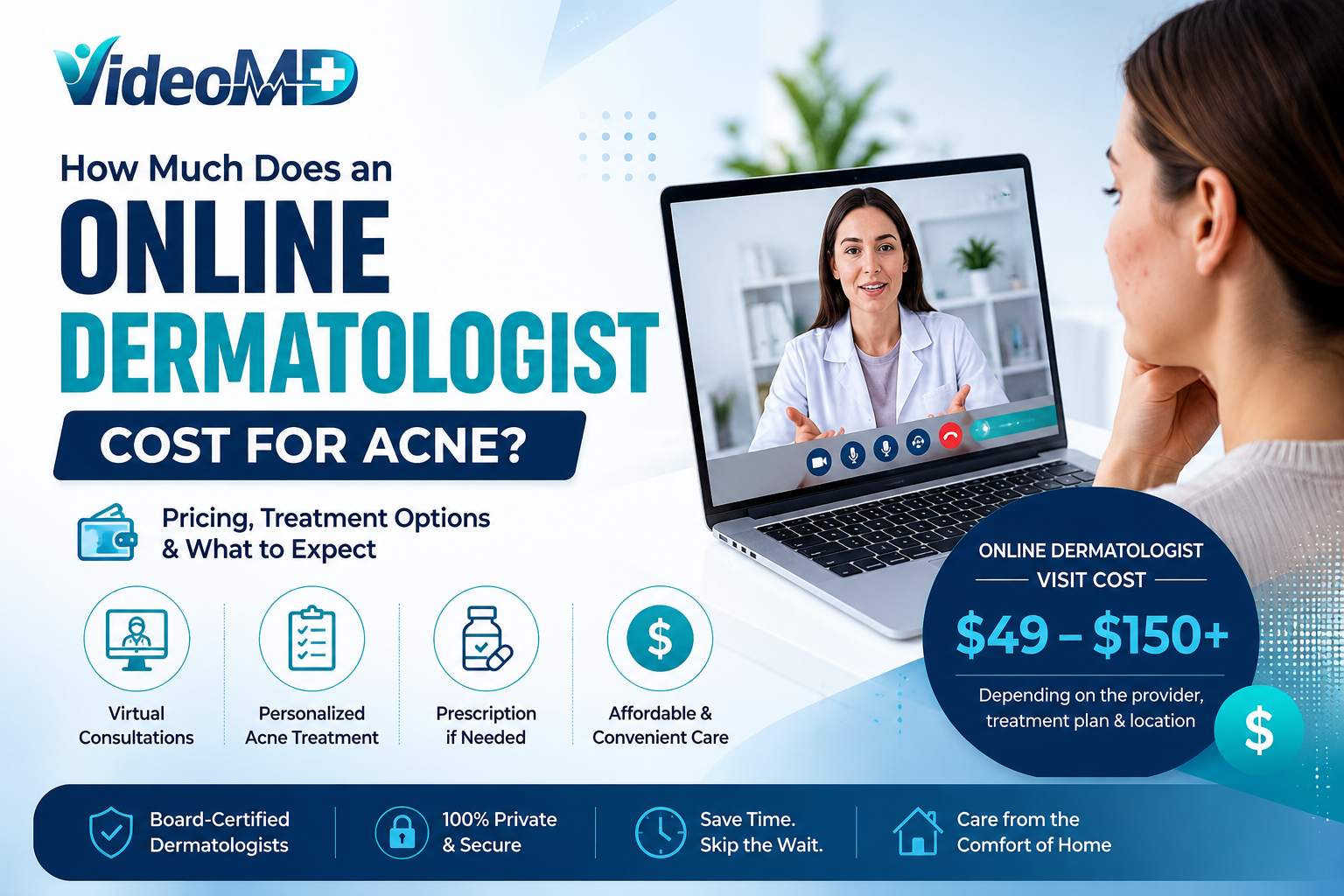
Online dermatology consults are consistently cheaper than in-person visits, often by a wide margin. And because you’re doing it from home, the “hidden” costs , travel, time off, the inevitable parking ticket , drop to zero. Many platforms also bundle follow-up messages or check-ins into the initial fee, so you’re not paying again just to ask a clarifying question a week later.
If your insurance covers telehealth (and many plans now do, especially post-2020), you might pay nothing more than your standard specialist copay , same as you’d pay in person, just without the commute.
What Online Dermatology Is Genuinely Great For
Here’s something the internet doesn’t always make clear: online dermatology handles a surprisingly wide range of conditions well. It’s not just for minor, inconsequential stuff. For a lot of everyday skin concerns, a virtual dermatologist gives you the same outcome as an in-person visit, faster and for less money. Also, it helps busy professionals to handle the online doctor’s consultation.
Conditions well-suited to virtual care
- Acne, mild to moderate, including hormonal breakouts
- Rosacea and chronic skin redness
- Eczema and dermatitis flare-ups in established patients
- Psoriasis management and prescription renewals
- Hair thinning and androgenetic alopecia
- Hyperpigmentation, dark spots, and melasma
- Minor rashes that photograph clearly
- Prescription renewals for conditions you already know you have.
The pattern here? Conditions that are visually diagnosable, chronic, or already established. If a doctor can look at your skin and make a clinical decision, and your photos are clear, there’s no medical reason that interaction has to happen in a room.
When You Genuinely Need To Go In Person
Online dermatology isn’t magic, and good platforms will tell you this honestly. There are situations where in-person care isn’t just preferable, it’s necessary. Knowing the difference protects you.
Cases That Require A Clinic Visit
Any mole or lesion that has changed shape, colour, or size needs to be seen in person. A dermatologist examining a suspicious spot needs a dermoscope, a specialised handheld device that sees beneath the skin’s surface, and no camera on your phone can replicate that. If there’s any chance something needs a biopsy or excision, you’re in clinic territory.
Similarly, full-body skin cancer screenings are an in-person event. So are cystic acne treatments involving cortisone injections, wart removal, and any procedure that requires a steady hand and a sterile environment. The rule of thumb: if treatment requires touching you, it requires a room.
A good virtual dermatologist will always tell you when your case exceeds what they can safely handle remotely. If a platform never refers anyone out, that’s actually a red flag, not a feature.
The Quality Question: Is Cheaper Actually Worse?
This is the question everyone has but not everyone asks out loud, so let’s just say it directly: no, cheaper doesn’t mean worse, but quality varies by platform, and you should know what to look for.
What Separates A Good Platform From A Sketchy One
The gold standard is a platform where your online dermatologist consultation is reviewed by a board-certified dermatologist, not a general practitioner, not a nurse practitioner filling a gap. Board certification in dermatology means years of residency specifically in skin conditions. It matters.
Beyond credentials, look for HIPAA compliance (your health data should be protected, full stop), a clear referral process for cases that need in-person escalation, and transparent pricing before you start the intake process. If a site is cagey about what you’re paying or who you’re seeing, trust that instinct and keep looking.
Well-regarded platforms in this space include Video-md.com, Apostrophe, Curology, Teladoc, Hello Dermatology, and MDLive, all of which use licensed, board-certified dermatologists and have clear data privacy practices.
Insurance, Hsa, And The Money Stuff Explained Simply
Insurance coverage for telehealth expanded a lot after 2020, and most major insurers now treat synchronous telehealth visits the same as in-person ones for reimbursement purposes. That means if your plan covers specialist visits with a copay, it likely covers a live video call with a virtual dermatologist the same way.
The Asynchronous Exception
Photo-based, asynchronous consultations are where it gets patchier. Not all plans cover them, and coverage varies significantly by state and insurer. The good news: even without insurance, these consultations tend to be affordable enough that many millennials find it cheaper to pay out of pocket than to deal with the in-network paperwork dance.
Your HSA or FSA can cover this
If you have a Health Savings Account or Flexible Spending Account, telehealth dermatology consultations typically qualify as an eligible expense. That means you’re paying with pre-tax dollars, which quietly makes the cost even lower in real terms. Worth checking with your plan, but most legitimate telehealth platforms are FSA/HSA eligible.
The Honest Takeaway For Millennials Specifically
People didn’t invent telehealth, but they did normalize the expectation that healthcare could work like everything else in your life, on demand, from your phone, without a month-long wait and a half-day calendar block. Online dermatology fits that expectation well for the conditions it’s designed to handle.
If you’re dealing with acne that won’t quit, a prescription you need renewed, or a skin concern that’s been living rent-free in your head for weeks, an online dermatologist consultation is probably the right first move. It’s faster, it’s cheaper, and for the majority of skin concerns, it’s clinically equivalent to walking into a clinic.
If something is changing, bleeding, growing, or genuinely scaring you, go in person. That’s not being dramatic. That’s being appropriately cautious about the one organ that covers your entire body.
The smartest approach isn’t picking a side. It’s knowing when each option is actually serving you, and using both accordingly.
Tell us what you’re dealing with, and I’ll help you figure out whether online dermatology makes sense for your situation, or if an in-person visit is the smarter call.